What Is A Horse Headstall? - Page 2 of 2
<<< continued from page 1
Attaching The Bit To The Headstall
There are almost as many ways to attach a bit (or bosal, nose piece, etc.) to a horse headstall as there are headstalls.
In the text and photos below we'll take a closer look at two common methods, Chicago screws and leather strings.
Chicago Screws
Chicago screws are a type of screw used for a wide variety of purposes. They are extremely popular in the horse industry to attach a headstall to a bit (or bosal, nose piece, etc.).
Chicago screws have two pieces, the head with a threaded post on the back, and the screw. To attach the headstall to the bit (or whatever), the bit is placed inside the ends of the cheek pieces, then the post on the back of the head is inserted through a hole on the outside of the cheek piece while the screw is inserted through a hole on the inside.
Then the screw is screwed into the post on the back of the head.
Below: A Chicago screw attaching a bit to a headstall.
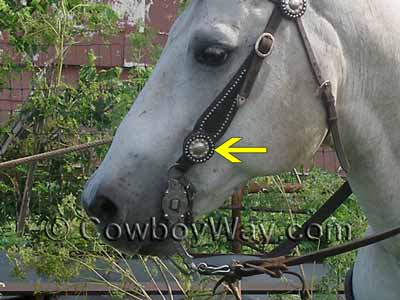
Chicago screws come in a wide variety of styles. Not only can the heads be large or small or fancy or plain, the screws come come in a variety of lengths.
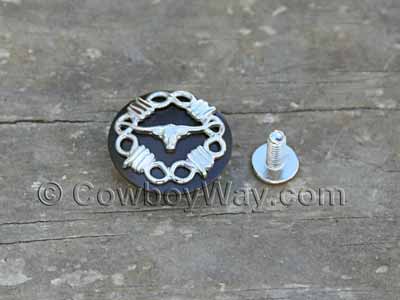
Below are close-up photos of a Chicago screw. The first photo shows the head right-side up. The head is about about the size of a quarter and is decorated with a steer's head and a border.
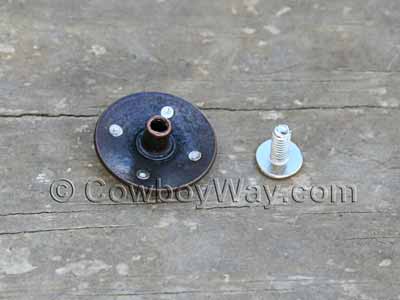
The second photo shows head of the screw upside down. The screw, visible to the right of the head in both photos, is about a quarter of an inch long.
Below: A Chicago screw: The head (on the left) and the screw (on the right).
Below: The same Chicago screw as show above, this time with the head upside down.
In order to attach a bit to a headstall securely Chicago screws need to have a post and screw that are long enough to reach through the cheek pieces of the headstall and screw securely into one another, but no longer.
Chicago Screws Pros And Cons
When it comes to attaching a bit (or bosal, nose piece, etc.) to a headstall every method has its pros and cons.
With Chicago screws, the pros include simple attachment, a wide variety of choices in style, design and price, and wide availability.
The biggest con with Chicago screws is that they can come unscrewed without being detected, possibly allowing the headstall to detach from the bit without warning during a ride.
If you use Chicago screws with your headstall, here are some tips:
- Check their tightness frequently. To make this simple keep an inexpensive screwdriver in your tack trunk, brush caddy, or some other location where it is handy and you will see it frequently. When you see your screwdriver, check your Chicago screws.
- Put your Chicago screws on with a dab of glue. This can be pretty annoying the next time you want to remove a Chicago screw, but it's better than your headstall falling apart during a ride. If you use glue, still check the tightness frequently.
- If you give a headstall with Chicago screws to someone as a gift, also give them a screwdriver.
- Keep extra Chicago screws handy in case you lose one. Some of the less expensive ones are sold in packages with several Chicago screws in them. Keep some of these with your screwdriver for quick repair jobs.
Leather Strings
Leather strings are also very popular for attaching a horse headstall to a bit (or bosal, nose piece, etc.). To attach the headstall to the bit (or whatever), the bit is placed inside the ends of the cheek pieces, a leather string is pushed through small holes in the cheek pieces from the inside out, and the strings are tied on the outside.
Since leather strings don't slide easily against themselves, a simple overhand knot pulled tight is usually all that is necessary.
Leather Strings Pros And Cons
The pros of using leather strings are simple attachment, inexpensive replacement, and wide availability.
The biggest con is probably that many riders don't check the strings very often and they can become dangerously worn or weather damaged and prone to breakage unless they are replaced.
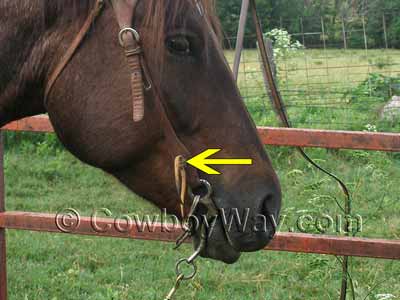
If you use leather strings with your headstall, here are some tips:
- Check them often to make sure they are still tied tightly, and that they are not damaged and need replaced.
- When tying them, leave long tails to help insure they don't accidentally come untied.
- Keep replacement strings in your tack trunk, brush caddy, saddle bags, or anywhere they will be fast and convenient to get to. You can buy a sack of leather strings of various sizes at many tack stores and trim some of them (if necessary) to use on your headstall.
- Consider using nylon shoestrings instead of leather. The nylon will wear better and resist weather damage (but even nylon should be checked frequently). If you do use nylon strings, keep in mind that nylon is more apt to slide against itself than leather is, so you'll need to tie a more secure knot.
What Is / Are...
… What Are 5 Of The Biggest Wild West Robberies?
… What Are 5 Reasons Horse Trailer Lighting Matters?
… What Are 8 Dumb Things To Say To A Horse Lover?
… What Are 9 Proven Ways To Keep Flies Off Horses?
… What Are Chestnuts and Ergots?
… What Are The Parts Of A Western Saddle?
… What Are Saddle Rigging Positions?
… What Are Some Fencing Options?
… What Are Some Foods Both Horses And Dogs Can Eat?
… What Are Some Horse Fencing Basics?
… What Are Some Interesting Horse Facts?
… What Are Some Interesting Charts and Graphs With Horse Information?
… What Are Some Options For Temporary Horse Fencing?
… What Are Synthetic Saddles Made Of?
… What Are The Rodeo Catch Pens?
… What Are The 10 Best 3-Horse Trailers With Living Quarters In The USA And Canada?
… What Are The X's In A Cowboy Hat?
… What Are The Three Legal Head Catches?
… What Is The Angle System For Branding?
… What Is The Barrel Racing Pattern?
… What Is A Bull Riding Vest Made Of?
… What Is Deworming Your Horse?
… What Is A Domain Name?
Why would I need one for my farm or ranch even if I don't have or
want a website?
… What Is A Fifth Wheel Trailer Hitch?
… What Is Flag and National Anthem Etiquette At A Rodeo?
… What Is A Slant Load Horse Trailer?
… What Is Floating A Horse's Teeth?
… What Do Horse Freeze Brands Look Like?
… What Is A Galvayne's Groove?
… What Is A Gooseneck Trailer Hitch?
… What Is Some History About The First National Finals Rodeo?
… What Is The History Of The Modern, Hornless, Bronc Riding Saddle?
… What Is The History Of The Modern Rodeo Bucking Chute?
… What Is The History Of The One-Hand Bareback Rigging?
… What Is The Nasolacrimal Duct In Horses?
… What Is A Pony Express Mochila?
… What Is Hermann Oak Leather?
… What Is Larvicidal De-Worming?
… What Is The Flehmen Response?
… What Is The Rodeo Return Gate?
… What Is A Safety Tip For Posting The Colors?
… What Is A Slick Fork Saddle?
… What Is A Swell Fork Saddle?
You Might Also Like